Business 101: We’re all in sales.
Do you cringe at the thought? Why?
One of the main reasons is our attitude: We think selling is ‘I win, you lose’. It’s something I do to you.
But in reality, the best salespeople honestly believe it’s a win–win. You need what I have, and I’d be remiss if I didn’t help you get it.
If you’re in business, you’re in sales, even if ‘sales’ isn’t in your job title. Because the basic human exchange of business—one person getting another on board with an idea, product or service—is sales.
That’s why we’re always on the lookout for good persuasion examples. And one of the toughest persuasion fields is ‘cold’ emails.
Recently I received the one below. Even if you never write ‘cold’ introduction emails, keep an open mind: What can you learn and apply to the persuasive messages you do write?
Click the image below to enlarge it and see my comments about what he did well.
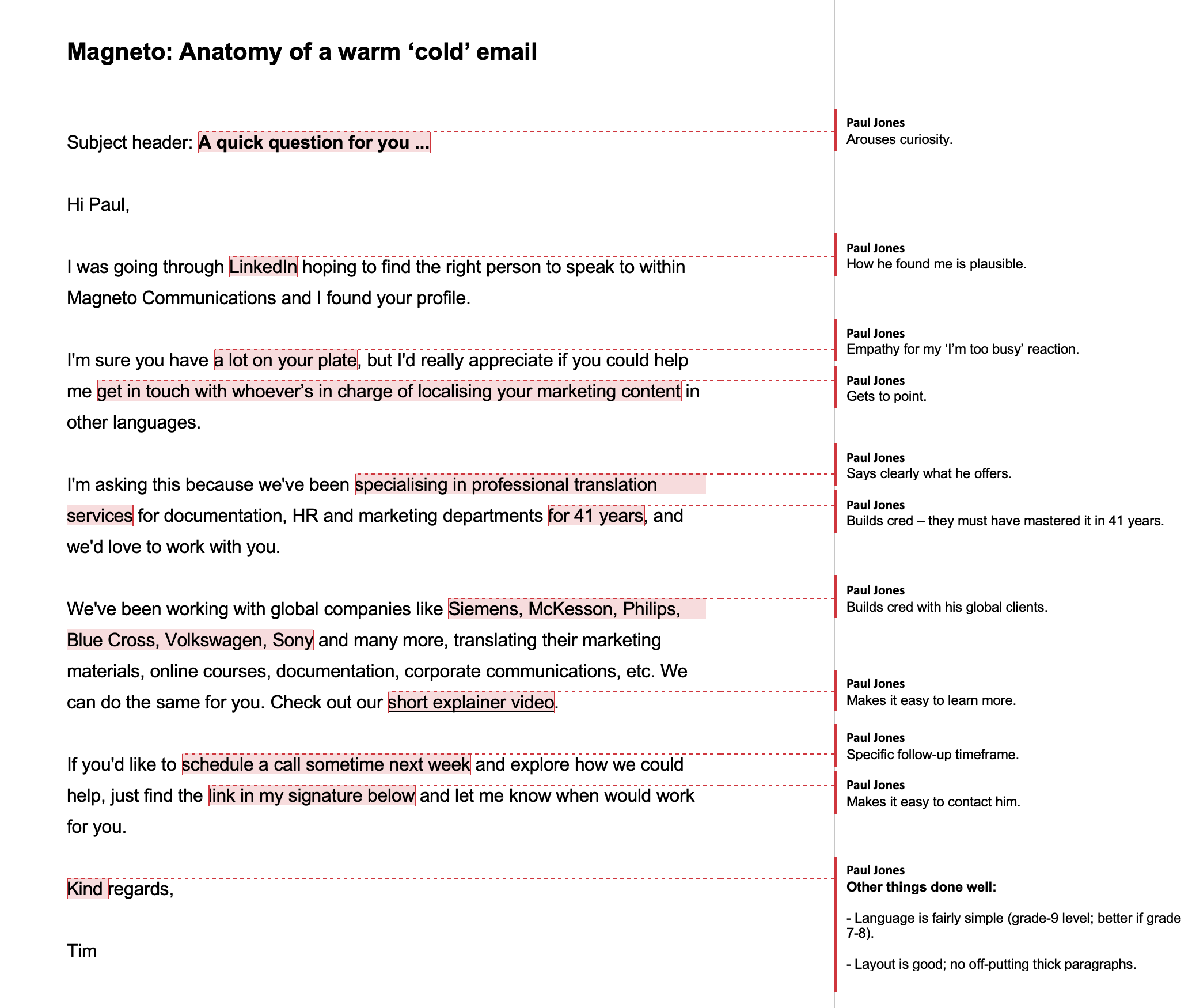
What could be better? Add ethical persuasive psychology
If you really want to increase your influence, here’s what he could’ve done better (the art lies in picking and choosing; use them all and it gets too long!):
‘Liking’
Adding a sincere compliment at the start could boost ‘liking’: see our Incognito Influence PDF.
Another ‘Liking’ booster that heats any ‘cold’ email is mentioning a mutual friend: ‘Paul, I was talking to Jo Bloggs [mutual contact], who mentioned you and your business …’
Reciprocity
He could have offered me a small ‘gift’, like some useful insight or advice, e.g. ‘Paul, I analysed some of your product’s text and found …’
I’d then feel obliged to ‘repay’ him, maybe with a response or a little time.
Objections
He could have proactively countered common objections he’s come across, e.g. ‘You might think it’s too hard to create different language versions of your product. But our XYZ process, refined over 41 years, makes it surprisingly easy.’
Homework
It would have been more powerful if he’d done some homework on me and/or our products, e.g. ‘I noticed your software and online courses are all in English. How much profit are you leaving on the table by excluding the 6 billion non-English speakers?’ … Then mentioning a client who made a gazillion translating into other languages.
Audience goals
One of our goals is to help as many people as possible. Plugging in a fact about the number and percentage of non-English speaking people would have gotten my attention: ‘Paul, did you realise 80 percent of the world can’t speak English? That means 6 billion people are missing out because they can’t access your products.’
Framing
Framing could have been useful here, e.g. reframing around fairness: ‘Translating your product into other languages is the great equaliser – suddenly millions of other people can use your product, no longer discriminated against because they can’t speak English.’
Personality
If he knew I was an Expressive (instead of Driver, Amiable or Analytical), he could have emphasised things that resonate with my style, such as the big picture, the future, e.g. ‘Imagine if 90% of the planet could access your product.’
Your two cents?
Do you agree? Disagree? What would you change? Love to hear your thoughts in the comments below.
If 2020 is your year to master persuasion, check out our popular program Write for Influence. It brings to life powerful principles of persuasion and influence in a practical framework with many before/after examples.
Paul & the Magneto/Credosity Crew

Get more YES
Your 2020 game-changer
Our one-day course trains you to be more influential and persuasive. It’s based on research-proven, evidence-based principles.
You’ll walk away with a comprehensive toolkit of insights and psychology you can apply on the page and face-to-face, at work and at home.
Learning outcomes
- Lead and influence effectively
- Use insights into audience psychology to connect with diverse audiences
- Understand a framework of proven persuasion techniques
- Apply a selection of tools for advanced influence challenges.
What people say about ‘Write For Influence’